Wednesday, June 12, 2013

Prague

On the train to Prague or Praha 6/11, Tuesday morning.  We asked the hotel to get our train tickets which they did for a fee of 2euro per ticket.  Well worth it since the line to buy tickets when we arrived into Budapest was miles long.

So we packed a lunch snack since our train ride is 6 1/2 hours long.  A good reason to take the train.


Day 1  Lessons unlearned.  We thought we would ask our hotel to purchase our tickets to Berlin on Sunday as it worked so smoothly in Budapest.  Guess what, doesn't work that way.  So we decided we needed to get the tickets for Berlin in our hot little hands so we could just enjoy our touring of Prague.  Our adventure was a little like the skit "Who's on first" with Abbot and Costello.  Our first challenge was getting to the under ground, figuring out what kind of tickets to buy, how many coins we needed, how many minutes each ticket was worth.  We didn't have enough coins so there was a tabak store which sells tickets.  We needed 6 30 minute tickets, the lady only had 5 but she would have more tomorrow!  Come back she says!  Finally get to the train station, find a line to buy "international" train tickets, order two one way trips to Berlin on the 10:29 train for Sunday.  All is good until the lady wanted paid.  Don looked at me, I looked at Don.  "Surely you have a credit card!"  After a one hour trip back to the hotel, retrieve credit cards, back to the train station and finally able to buy tickets to Berlin.  It was now time for a beer!  That was the first half of our day.  Oh, the joys and challenges of traveling.  Yes, we still like each other!

A little about Prague.  It is city in the province of Bohemian in the Czech Republic.  It is originally a city of four towns:   Castle Quarter, Little Quarter, Old Town and New Town.  The 30 year war between the Protestants and the Catholics started in Prague in 1618.  The Catholics won.  After WWII, the Russians took over Prague.  It became a Socialist Republic until the Velvet Revolution in 1989. 

We spent the afternoon of 6/12 touring New Town which included Wenceslas Square.  You know Good-King Wenceslas of Christmas fame.  This is the same square that the Velvet Revolution occurred.


New Town is home to Art Nouveau.  Why "nouveau"?  It was born in Paris and was not inspired by Rome.  It is neo-nothing.  It liberated the artist in the architects.  They were free to do as they pleased.  We visited the Mucha Museum.  Alfons Mucha was one of the most famous artists of the Art Nouveau movement. His art is readily recognizable for the posters he did for Sarah Bernhardt and others artists. Check him out on Google.  He is a contemporary Maxfield Parrish.  Pic 1 Jewish Synagogue, Pic 2 the Municipal House, Prague's largest concert hall.


Special note, Czech beers are famous around the world.  Budweiser was originally a Czech beer.  The American brewery adopted its name after a visit to Bohemian in the 19th century.  The term Pilsner beer comes from Pilsen,a Bohemian town famous for the best Pilsner beers in CR.  .  No one here would drink beer out of a can!

Day 2 we toured Old Town which included The Jewish Quarter called Josefov. Of the 120,000 Jews from this area sent to concentration camps, only 10,000 survived.  Here are a couple pictures of the Jewish Cemetery and the Spanish Synagogue.


In the center of Old Town is the Tyn Church.  it is a Catholic Church now but spent 200 years as the leading church of the Hussite movement.  Buildings have been built all around the church now.


Other views are the Astronomical Clock. A statue to Jan Hus stands in the center of the square.  He was the leader of the Hussite movement.  Hus lived a century before Martin Luther but they espoused the same doctrines that condemned church corruption, and promoted local religious authority.  The last picture is of the Havelska Market which is an air market dating back to the 13th century.


Day 3 we toured/walked the Castle Quarter, the roost of Czech rulers for over 1,000 years.  The "Palace " is not just a palace but a collecion of churches, public buildings, gardens and a Monastery.  St. Virus Cathedral is the Roman Catholic cathedral that symbolizes the Czech spirit because it contains the tombs and relics of the most important saints and kings including the first three Hapsburg kings.  A Mucha stained glass window is an important part of the church.  We met him  on Day 1 in New Town.  He is the father of Art Nouveau.  St. Winceslas (day 1) is also buried in this church.


From the Strahov Monastery, which was self sufficient we see a beautiful panoramic view of Prague.  


Day 4 we just roamed.  We looked up at fabulous facades on buildings.  Sometime you miss those little details because you are so focused on where you are going.  We saw brides being photographed in the historic sites.  A small wedding took place in the 11th century Rotunda, a small catholic church.  We took alley ways that we swore were new only to end up at a site we had toured previously.  Prague is a very small city.  If you were to walk the longest site seeing trail they have you would only cover 2.8 miles.  Because it is so small, it seems like we tourist as just packed in and we are, into a very small area.  We stopped into La Bottega de Finestra for a little lunch of wonderful cheeses, salami and prosciutto and wines.  The foods range from traditional Czech, French, Vietnamese, Italian, Indian, Irish, Thai, McDonalds, Burger King and KFC.  Something for everyone!  All the high end designers are here, Chanel, Prada, Tiffany, Guicci, Feragamo, and on and on.  No temptation to buy anything.

Tomorrow we leave for Berlin where we connect with Janet and Dave for 8 days.  It will be fun having travel companions.


11th century Catholic Church Rotunda


Gate to the Charles Bridge 

Monday, June 10, 2013

Budapest

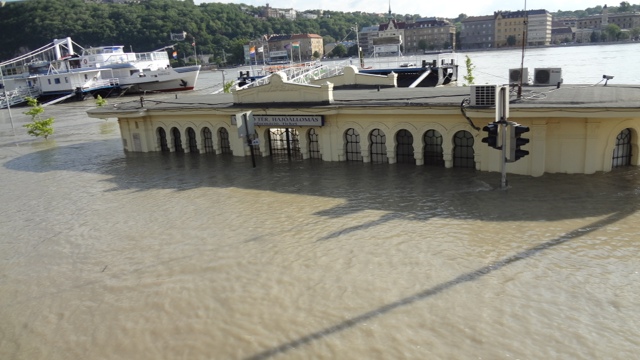
I'm here to tell you that Budapest is still standing despite the extreme flooding that is occurring on the Danube River.  The water is above it normal banks by 30 feet!  Roads, tracks, tunnels are gone.  On Sunday, I believe all of Hungary descended on Budapest to witness the river crest.  The last one they had like this was 10 years ago.  Before that was 100 years.  This flooding took Europe a bit by surprise but they are handling it so well!  Here are a few pictures of the river.


In spite of the river situation, we found Budapest to be a beautiful city influenced by Vienesse and Parisian architecture.  It used to be two major cities, Buda to the west of the river and Pest to the east of the river.  It was unified in 1873 after the fall of the Hapsburg dynasty.  It is a city of bridges, all of which were destroyed during WWII.  Hungary was under Russian rule until 1989.  It joined the E.U. In 2004 but still retains its own currency.  It became a UNESCO World Heritage Site in 1987.  We enjoyed taking all of the walking tours available to see most sections of the city, new and old.  They have a wonderful "Great Market Hall" next to the Liberty Bridge.  


Here is bed #15, Budapest Marriott.


The Great Market Hall.  My vision of what the market looked like in old Allegheny City before they tore it down.


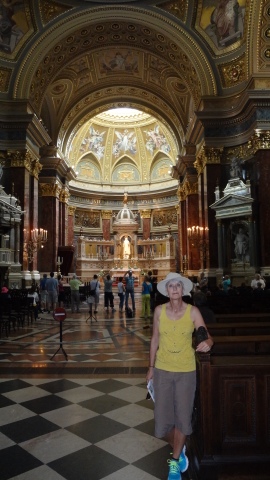
St. Stephan's Basilica 


Other views of Budapest.  Tomorrow we leave for Prague.


Saturday, June 8, 2013

Vienna

Vienna is a beautiful and viberant old and new city of 1.5million people.  The old city is alive with high end shopping, waking strasses, outdoor cafes, beautiful buildings and tourists!  Outside the city center is filled with people bustling off to work, school, market, same as our everyday life.  The public transportation system is fantastic.  For 6.80 euro you get a ticket for 24 hours to ALL modes of public transportation; trams, subway, buses.  We stayed outside the old city center but were only 4 stops away by underground.  

We visited St. Stephens Cathedral built between 1147 and 1433.  It is Romanesque and Gothic in style.  Many of the Hapsburgs are interned in this church but only their bodies, their hearts are in another church.  Check out the special lighting effects.  


We toured Schonbrunn Palace.  Schonbrunn means "beautiful spring".   The water in Vienna is said to be the best, not chlorinated and straight from the springs.  This was the home of Maria Theresia and Franz Joseph.  They had 12 children.  All but one girl was married off to other political leaders in order to strengthen the Hapsburg empire.  The one girl was allowed to marry for love.


Our favorite stop was the Naschmarket!  We had a delicious lunch of grilled salmon, buttered potatoes, sauted veggies, sauted fresh spinach.  The market is a mixture of typical Viennese market stalls and Oriental bazaar atmosphere.  Fresh fruit, exotic spices, textiles, flowers, meat, fish.  It reminded us of the night markets in China and the Strip District in Pittsburgh.  The best of both worlds.


A couple pictures of old town Vienna.


Wednesday, June 5, 2013

Off to Salsburg and Vienna

6/3 and heading to Salzburg.  Stopped in Ettal to visit a 13th century Benedictine Monastery built by the Holy Roman Emperor.  There are now 50 some monks living at the Monastery.  The monks make a delicious liqueur which we had to sample and buy.  Medicinal, you know.  As you can see it is a very ornate monastery as are most of the Catholic Churches in Bavaria and Austria.  Pictures 1 and 2

Salzburg was founded by the Celts around 1000B.C.  The area was very rich with salt mines which was used to preserve food.  Around 2 B.C. the Romans took over Salzburg.  The "salt roads" were developed by the Romans, much like the silk roads in China.  Salt was a precious commodity, worth its weight in gold.  The Holy Roman Empire, ruled by  Charlemagne, took over around 400 A.D..  The Hapsburgs took over in 1220 A.D. until the first WWI.  The Treaty of Versailles changed the Austrian empire forever.  Everyone wanted a piece of the action.  Don is reading "Salt A World History" by Mark Kurlansky.   It is a very beautiful city as show in picture 3.

6/4 we took a tour to Berchtesgaden, a Nazi mountaintop retreat, a complex bunker system and the Eagles Nest.  Starting in 1943 the Germans oversaw  Italian laborers (slaves) dig over 4 miles of tunnels through the mountains for the SS protection as the war was getting closer to their home.  They still thought they could win even though troops were asking Hitler to capitulate.  Hitlers home , Berghof, as well other SS housing was destroyed during Allied bombings. The Eagles Nest was not harmed because it was hard to spot.  It is a three room conference center.  Hitler visited the eagles nest only 14 times.  He was acrophobic and claustrophic . Picture 4 is in the tunnels and 5 is at the top of the Eagles Nest.

6/5 off to Vienna.  Today we turned in our little Clio and dependable GPS,  Inga..  The rest of our travels will be by trains.  


Saturday, June 1, 2013

Ludwig II

Saturday, 6/1, Heading to Austria today in the rain.  Guess we have a theme going here. We stopped at a gas station on the highway to buy an Austrian sticker for our car.  Even though we are still in the E.U. each country requires a sticker (tax) on a car that allows you to drive on their roads.  The cost is 8.30 euro, the fine is 120 euro.  Better safe than sorry, right?  It was a nice drive heading straight for the alps.  The mountains are still covered with snow.  The waterfalls are heavy, the rivers swollen.  This is the wettest May they have had in 12 years according to Hans, our inn keeper at Becks Hotel and Cafe in Ruette, Austria.  We stopped for a short walk around in Oberammergau, the home of the Passion Play put on only every 10 years.  We are reading about "Mad" King Ludwig II who ruled Bavaria for 22 years until his death at the age of 40!  He lived his last years in his family home Linderhof in Austria as a recluse until his death in Munich.   Ludwig completely  remodeled the castle in the French style of Louis XV.  He was all about France.  The paintings, the architecture, the life style all copied the French style.  Louis the XV was his idol you might say.    Pictures:  1 Oberammergau, 2 and 3 Linderhof Palace


Sunday,6/2 we toured Neuschwanstein Castle another of Ludwig II's palaces.  It was in construction from 1869 to 1886, when he died.  He lived in this castle a total of 172 days.  He drained the state coffers building his romantic castles.  In June 1886 he was declared mentally unfit and evicted from Neuschwanstein.  Two days later he was found dead in a lake.  Sucide or murder, no one knows for sure.  Does the castle remind you of someplace you might have seen in either Disneyworld or Disneyland?  1. Neuschwanstein 2. View up to Mary's bridge.

Tomorrow we "attempt" to drive to Salzburg.  Southern Germany has had soooo much rain that the roads are now flooded.  The A8, which is the main autobahn between Munich and Salzburg, was closed all day.  Over 100 highways have been closed due to flooding.  Inge and Hans, our hosts are keeping us posted and promise to hold a room for us tomorrow night if necessary.  In the meantime over 2,000 metallurgical engineers from around the world are descending on this small town of Ruette for a conference.  Every inn and hotel is booked for the upcoming week!

Munchen


We headed to Munchen for two days in the rain.  Will it ever dry up In Europe?  It looks like a storm has settled in for awhile.  Glad I brought a raincoat and an umbrella.  Both are getting quite a lot of use.  Plus, I'm starting to layer up more because it is cold.  pretty soon I'll be wearing all my clothes!

We did a tour of the Dachau Memorial on Memorial Day in the U.S.  Quite appropriate.  Needless to say it was very moving to stand in the area where over 32,000 people died because of disease, were shot to death or were exterminated in the most inhumane way.  It was originally used for political dissidents but after the war broke out the Nazi's found other purposes for Dachau.  It was only one of hundreds of such labor camps in Germany.  The photos are at the date of the camp.  The motto was "Work will free you".  The second photo represents the color of insignias that a prisoner worn on their clothes to identify them as political prisoner, Jew, theif, sexual offender, religious objector, etc.


We settled into our little hotel in Munchen, the Ibis and bed #9.  The under ground system here is easy to use so we headed into town for dinner at the Hofbrauhaus, the most famous beer garden in Munchen.  It is loud, rowdy, filled with tourist and has a great oompah music!  You grab a seat wherever you can.  We sat with a family of 8 from Chicago who were on holiday together.


On Wednesday we toured downtown Munchen, again in pouring rain.  Are we hardy or what!?!?
First stop was the BMW Welt.  We went primarily to see the building, a cloud-shaped,  glass and steel architectural masterpiece.  It is Munchens BMW showroom and it was packed with curiosity seekers.  We did see people test driving and also picking up their pre-ordered cars.  

Next stop was Dallmayr Delicatesen!  This is where the Bavarian King called for "take out".  It is famous for its food items, fine wines, chocolates, meats, cheeses.  We stopped to have a glass of champagne and a plate of smoked salmon.  Just what I needed after drinking only beer and eating pork and sausage.  They have a motto on the wall, "Save water, drink champagne".  

We toured the The Residenz, a gilded royal Bavarian palace for Maximilian I.  It's outside is modeled after the Medici's Pitti Palace in Florence.  It has a mere 90 rooms and the are decorated in Rocco and very ornate.  No tour of Germany is complete without a visit to one of their churches so we stopped into St. Michael's which was originally built in the late 1500's as home to the Bavarian Jesuits.  Most of Munchen was destroyed during the WWII and they have done an amazing job of recreating the old city.  Our last stop was at the Viktualienmarkt.  The  government keeps a close eye on what is sold here in order to keep it classy and authentic outdoor market.

Did I mention that we had rain all day, sometimes very heavy with high winds!